Introduction
Every year, homeowners break ground on a fence line, a new patio, or a simple flower bed and strike something they never expected: a buried tank, a crushed pipe, or a saturated drainfield that starts backing up sewage into the house. The damage doesn’t announce itself first. It shows up later, as a collapsed lid, a foul odor spreading across the yard, or a plumbing system that suddenly refuses to drain. We at Best Septic Tank Pumping have been in these situations more times than we can count, and almost all of them go back to one missed step: not getting a proper septic locating service before the shovels came out.
This blog breaks down the clearest warning signs that your property needs a professional locate before any digging begins. We’ll walk through what triggers the need for septic tank locating, how the process actually works underground, and why guessing at a septic tank location almost always costs more than confirming it.
Why Septic System Location Matters Before Property Improvements
A septic tank doesn’t merely get buried; it often gets forgotten. Records get lost, previous owners move away, and yards change shape over decades of landscaping. Without an accurate septic system location, every excavation project is a gamble.
Knowing the precise septic tank location protects your plumbing, your yard, and your wallet from damage that’s often invisible until it’s already done.
Sign #1: You Recently Purchased an Older Home
Many older homes, built before modern permitting standards, are missing or have incomplete septic paperwork. County files often have a rough sketch rather than measured coordinates and rarely have extensive notes left by previous owners.
If you’ve just closed on an older property, don’t assume the county record is accurate. A confirmed locate through professional septic services removes the guesswork before you ever pick up a shovel.
What Outdated Records Actually Miss
Long ago, before GPS mapping, health department files were often drawn by hand. Distances were estimated from the foundation and not measured precisely, so the tank on paper can be several feet from the tank in the ground.
Sign #2: You Are Planning Landscaping or Outdoor Renovations
Tree roots are one of the most common causes of underground pipe damage, and they don’t stop growing once they find moisture. In effect, a pipe carrying sewage is an irrigation line to a thirsty root system, and roots will aggressively grow toward that moisture.
The second risk is heavy landscaping equipment. Soil compaction over a shallowly buried line can cause pipe joints that were never designed to support that kind of weight to crack.
One missed pipe under a flower bed can undo years of careful septic maintenance services in a single afternoon.
Sign #3: You Are Adding a Pool, Shed, or Home Addition
Most local health departments require a documented septic tank location before approving permits for pools, sheds, or additions. Building too close to a tank or drainfield is not only a risk of damage, but it can also be a code violation altogether.
| Structure or Feature | Typical Minimum Distance from Tank |
| House foundation | 5–10 feet |
| Swimming pool | 15–25 feet |
| Driveway | 5–10 feet |
| Private well | 50–100 feet |
| Drainfield (from any structure) | 10–20 feet |
The numbers vary by county, but the pattern is the same everywhere: the drainfield always requires more space than the tank itself, because that is where the treated wastewater drains into the soil.
Sign #4: You Cannot Find Your Septic Tank Access Lid
Years of new sod, mulch, or soil settling can bury an access lid completely out of sight. What was once a visible cover at ground level can end up a foot or more underground within a decade.
A missing lid doesn’t mean a missing tank. A trained technician can usually find it in minutes, using tools designed for that sort of search, rather than probing around the yard randomly.
Sign #5: You Are Experiencing Septic System Problems
Slow drains and soggy patches rarely appear without a reason. When technicians can’t see the system, they can’t diagnose it efficiently, which means every guess costs time.
| Warning Sign | Likely Underlying Issue |
| Slow-draining sinks or tubs | Clogged line or full tank |
| Soggy, spongy, or unusually green patches | Saturated or failing drainfield |
| Sewage odor near the yard | Overflow or damaged lid seal |
| Gurgling sounds in plumbing | Blocked vent line or backup |
Accurate septic inspections trace these symptoms directly back to their source instead of relying on trial and error across the property.
Sign #6: Property Records Are Missing or Inaccurate
Septic systems get modified, expanded, or relocated over the years, and paperwork rarely keeps pace with those changes. A permit from thirty years ago may not reflect a repair done a decade later.
When documentation can’t be trusted, physical septic system maintenance planning has to rely on what’s actually in the ground, not what’s on file at the county office.
How Professional Septic Locating Services Work
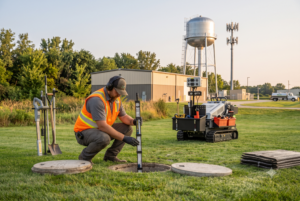
Locating a system isn’t guesswork, and it isn’t just probing blindly with a metal rod. Technicians combine several tools to build an accurate map before any digging starts, each suited to different soil types and tank materials.
1. Flushable Electronic Transmitters
A small transmitter, often called a sonde, gets flushed through the plumbing system and travels naturally with the wastewater into the tank. Once it settles, a handheld receiver above ground tracks its signal and pinpoints the tank’s exact position, often within inches.
2. Magnetic and Metal Detection
Older tanks frequently have metal risers, rebar-reinforced concrete lids, or steel access covers. Even those buried under several inches of soil and turf are quickly picked up by sweeping the area with a magnetic locator.
3. Ground-Penetrating Radar and Probing
With more complex properties, ground-penetrating radar maps out structures underground without disturbing the yard at all. Then technicians verify their findings with careful, targeted probing, rather than wide, speculative digging across the property.
Benefits of Hiring a Professional Septic Locating Service
Getting trained technicians for septic tank locating offers a level of accuracy that manual searching alone can’t match.
1. Precision: Equipment-based methods reduce guesswork to inches, not feet
2. Speed: Most tanks are located in a fraction of the time manual probing takes
3. Protection: Confirmed locations prevent accidental strikes to tanks, pipes, or drainfields
4. Documentation: A verified septic system inspection creates records for future projects, permits, or resale
These benefits quickly add up for homeowners planning more than one improvement project over the coming years.
Protect What’s Underground Before You Break Ground
Every sign covered here points to the same conclusion: assuming you know where your septic system sits is a risk no property improvement should carry. From older homes with missing paperwork to yards with buried access lids, confirming the location first prevents damage that’s often expensive and always disruptive to fix.
Best Septic Tank Pumping provides septic tank services and precise locating support throughout Springfield, Salem, Eugene, Florence, and the surrounding Willamette Valley communities. Our technicians use professional-grade transmitters, magnetic detection, and radar-based tools to map your system accurately, so your next project starts on ground you can trust.
If you are planning a renovation, need to locate your access lid, or just want documented peace of mind before you start to dig, don’t leave it to chance. Schedule your septic locating appointment today by calling our team at (541) 484-0844.