An Introduction
Most property damage doesn’t start with a storm or an accident. It starts with a single decision to dig without knowing what’s underneath. A septic tank can sit there for decades, quietly doing its job, until one excavation job breaks a line or smashes a drainfield that took years to mature. Once that happens, the damage can’t be fixed. At Best Septic Tank Pumping, we know how quickly a routine project can turn into a major repair when the system underneath the yard was never properly located in the first place.
This guide explains why septic location has to happen before any digging starts, what professional mapping and marking actually involve, and how locating services protect both the system and the property around it. We’ll also discuss a detail most homeowners don’t know until it’s too late.
Why Septic Location Should Come Before Digging
Many homeowners believe that 811 notification before a project covers all buried systems on their property. It doesn’t.
1.What 811 Doesn’t Tell You
The national 811 utility locating service maps public infrastructure: gas, electric, water, and telecom lines. Private systems, such as septic tanks, drain lines, and drainfields, fall completely outside that service. You can pass every utility check and still hit a tank or line unless a homeowner makes a separate call for a septic locating.
2.The Real Risk of Digging Blind
A shovel, auger, or excavator doesn’t know the difference between soil and a buried pipe until it hits something. When a line is cut or a tank lid is broken, the system no longer works properly, and wastewater can rise up in the yard or back up into the home until repairs are made.
Why Septic Location Matters Before Any Excavation
Fences, decks, sheds, and driveway extensions are some of the most common projects that intersect buried septic systems. The reason is simple: They’re often planned without a second thought about what sits below.
1. Compacted Drainfields Don’t Recover
A drainfield works because the soil around it stays loose enough to filter wastewater naturally. Heavy equipment driven over that soil, even briefly, can compress it enough to collapse the pore structure that makes filtration possible. Unlike a cracked pipe, compacted soil can’t be repaired. The affected section of the drainfield has to be replaced, and until that work is finished, the home may be without a functioning wastewater system entirely.
2. Setback Requirements Vary by Property
Most counties have setback requirements for septic systems from wells, property lines, and other water sources. Because setback rules vary by location, a system that was compliant at the time of installation may be closer to a new structure than a homeowner would expect, making locating even more important before any excavation begins.
A tank strike is a repair. A crushed drainfield is a replacement, and there’s no in-between.
Septic System Mapping and Marking for Safer Projects
Locating a system is only half the job. Mapping it turns that information into something a homeowner or contractor can actually use for every future project.
1. How Technicians Trace What’s Underground
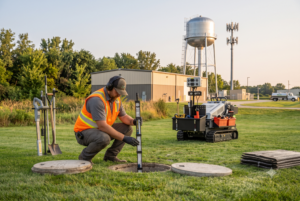
If your septic line has a metallic tracer wire, the transmitter sends a signal down the wire, and a handheld receiver trails it up to the surface. Older plastic lines installed without tracer wire require a different tactic. A small transmitter, called a sonde, is pushed through the pipe by camera or flexible rod, and its signal is tracked from above ground. And this is how septic pipe mapping can figure out depth and direction on systems with no records.
2. Turning a Locate Into a Usable Site Map
Once the tank, lines, and drainfield boundaries are traced, they’re marked directly on the property and recorded on a simple diagram. That diagram becomes a reference point for every future landscaping decision, so septic field mapping doesn’t have to be repeated from scratch each time a new project comes up.
How Septic Line Locating Services Protect Your Property
Underground septic line locating does more than prevent a single accident. It protects the long-term integrity of a system that’s expensive to replace and difficult to relocate once it’s established.
A property with a known, properly recorded system holds its value differently from a property with an unknown layout. It means that buyers, inspectors, and contractors all work from the same information instead of guessing, and it means that service calls in the future go faster because access points and line paths are known rather than rediscovered under pressure.
Prevent Septic System Damage and Control Long-Term Costs
Septic system damage prevention isn’t a single action. It’s a collection of behaviors that allows a system to function as designed throughout its design life.
| Habit | Why It Matters |
| Locate before any excavation | Prevents accidental line or tank strikes |
| Keep vehicles off the drainfield | Avoids permanent soil compaction |
| Watch for slow drains or wet spots | Early signs of a developing problem |
| Keep root systems away from lines | Roots seek moisture and can crack pipes |
| Schedule inspections on a regular cycle | Catches issues before they become emergencies |
Skipping any one of these doesn’t just risk an inconvenience. It could even lose the drainfield, the most difficult and disruptive part of the system to rebuild.
Septic Tank Access and Maintenance: Why Location Matters
A system that’s hard to find is a system that’s hard to maintain, and that alone causes more deferred maintenance than most homeowners realize.
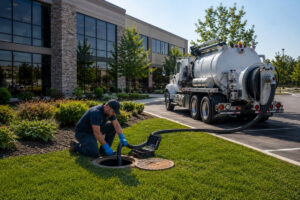
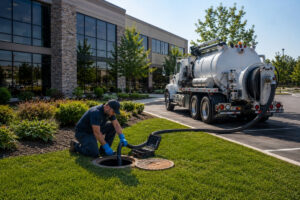
Riser installation solves this by extending access points to ground level, so pumping and septic system maintenance services no longer require digging to reach the tank lid first. Paired with accurate mapping, this means every future visit starts faster and disturbs far less of the yard than it would otherwise.
What Most Homeowners Get Wrong About Their System
The most common mistake isn’t neglecting maintenance. The assumption is that if a system has not yet caused a problem, there is no need to locate it before starting a new project. A septic system can sit right in the way of a planned fence line or garden bed and function perfectly for years. The only way to know is to check before, not after.
Know What’s Below Before You Dig
Every excavation project carries the same underlying risk: the parts of a septic system that keep it working are the same parts that are easiest to damage without warning. Locating, mapping, and marking the system before any digging turns that risk into something manageable, documented, and easy to reference for years afterward.
Best Septic Tank Pumping brings septic field mapping, underground septic line locating, and thorough septic system inspection services together for property owners across Lane County and the surrounding areas, including projects near Salem, Eugene, and Florence. Our technicians handle everything from tracing undocumented lines to setting up long-term access solutions that make future maintenance simpler.
If you’re planning any excavation project, or it’s simply been a while since your system was checked, don’t leave it to guesswork. Call Best Septic Tank Pumping at (541) 484-0844 to schedule your septic locating and inspection before the shovel hits the ground.